Rules or Relationship?

My oldest daughter just turned 16 and got her driver’s license.  Many people have asked me about our rules for her driving: What time is her curfew?  How far can she go?  Whom can she drive?  My simple answer is we focus more on our relationship than the rules.

IMG_5173

My husband majored in Family Science while doing his pre-med courses at BYU.  In one of his parenting classes he learned about this concept. He learned the importance of cultivating a relationship with your teenager over enforcing a long list of rules.  Many people think that when it comes to parenting teenagers you’ve got to “lay down the law” and battle them to get them to obey and behave.  Parents think you’ve got to establish a lot of rules and consequences and be on the lookout for any misbehavior or rebellion.  But there is a different way.  If you have nurtured a good relationship with your child, you can focus more on that bond for influencing good behavior than any rules and punishments.

This philosophy is based on an understanding of the developmental growth that occurs in the teenage years.  Growing up includes the process of separating from parents, and by the end of adolescence that separation should be complete.  Parents will and should have less and less influence.  In Parenting with Love and Logic the authors describe this situation with V and an inverted V as two symbols of children’s decision making as they age.  The upright V shows that when children are small (the bottom of the V), they are not making many decisions on their own.  The parents control most of their lives and make most of their decisions. Parental control decreases over time as children mature.  Children learn how to make more and more of their own decisions, and by the time they leave the house they are equipped with the skills to live independent lives.

Some parents mistakenly subscribe to the inverted or upside down V philosophy, where young children are given many liberties and allowed to make their own decisions (many of which may be beyond their developmental level). Then as the child grows, the parents clamp down and implement more rules (presumably to keep the rebelling teen in line). This is a vicious cycle because it leads to more rebellion from the teenager, followed by even more rules from the parents. This kind of cycle can dampen the parent-child relationship.  Interactions start to focus on reviewing and enforcing the rules and this leads to a more closed-off relationship.

With a strong relationship already in place, parents are ready to guide their children through adolescence with less and less control over their choices.  This doesn’t mean you don’t know what is going on with your child.  In fact, it is the opposite.  Through your relationship you know a lot about each other.  Rather than reviewing rules, you are getting to know your child in a more mature way, trying to understand what the child is thinking, learning, doing, and experiencing.  You have mutual respect and consideration, and you communicate about what is going on each day.  You know where your child is and what they are doing, not because they have to tell you, but because it is a natural part of your relationship.

In the context of a relationship, the child understands that she can’t come home whenever she wants, because her parents will be wondering where she is and would be worried about her.  She wouldn’t take the car without discussing it because the parent might need it.  In this system, parents expect the child to talk to them regularly, not just to inform them what she is doing, but to have an open discussion together.  This might include the child recognizing that what she has planned won’t work for the family as a whole.  For example, if a child says she wants to go to a friend’s house after the football game and stay out until one am, the dad might explain that the family has an activity planned early Saturday morning, and so she will need to come home earlier.

Don’t get the wrong idea that keeping a healthy, strong relationship with your teen is easy!  It takes work, patience, and self-control.  But it is possible, and it is preferable to viewing your teen as an adversary and trying to control her behavior with rules.  In the book How to Hug a Porcupine, the author goes into detail about how to create and maintain a positive relationship with your child from about age 9 on.  The tween years (9-12) can be the time when children start to get “prickly,” harder to love and more distant.  The author describes how to overlook the difficult but normal behaviors (similar to the difficult toddler behaviors I talked about in Why Is She Crying?!) and forge ahead with a positive attitude toward bridging the gap that your child insists on creating.  If you get in the habit of these helpful tactics, you will have a good relationship in place as your child enters the teen years.

Don’t expect that this will always go smoothly.  There may be a time when your child forgets or doesn’t want to communicate and just stays out late without explanation.  When this happens, try to keep you irritation in check and have a discussion (not a lecture or a reprimand).  The discussion centers on finding out what happened and why the communication broke down.  Give the child the benefit of the doubt, asking for her perspective rather than launching into a lecture about how terrible the behavior was or how it impacted you.  Believe the child wants to make good decisions and keep up the relationship, and reemphasize that expectation.  Assume the best of the child, and be surprised when she doesn’t behave in that way, rather than assuming the worst and trying to “catch” her in a mistake.  It makes a big difference to come at the relationship from this perspective.

Again, it’s not easy, but it is possible.  We are fortunate to have this foundation of a good relationship with our daughter (the new 16-year-old), and therefore don’t have a lot of rules in place for her.  She tells us where she’s going, whom she’ll be with, and when she’ll be back.  We decide on an appropriate return time depending on the particulars of each situation – week night or weekend, what the activity is, etc.  If she gets into a phase where she doesn’t want to tell us these details, where she wants to pull away emotionally and gets annoyed when we “make her” talk to us, we will remind her of this concept.  We’ll tell her that we prefer to have a relationship instead of a lot of rules, but that requires consistent and respectful communication.  We’ll be understanding and sympathetic, knowing this emotional separation is a normal part of growing up and not something to get annoyed about, but we’ll be firm in the fact that we need to know some of these details before she goes out.

Time Out

No parenting website would be complete without addressing the topic of Time Out.  Time out is a popular parenting tool, and can be used effectively, but it’s an ill-defined concept.  Your version of time out could be different than mine or anyone else’s, so I’ll start with some clarification.  One use of time out is as a break.  In this sense it is not a punishment or a sign of misbehavior necessarily, simply a neutral, unemotional separation.  If two children are having a hard time getting along you might see the need for a little break from each other and suggest a time out.  The children can go to different rooms and play something else for a specified or unspecified amount of time.  If two or more children are arguing over a toy and can’t find a good solution using their words, the toy might have to have a time out and be put away somewhere for a while.  Even moms can have time outs in this sense: a short period of time to be in your room alone. When interrupted you can explain to your children, “Mom needs a break for just a little bit, a time out.”

The more common usage, however, is time out as a punishment.  Parents know that spanking is no longer an acceptable general-use punishment, and they want something that they can hold over the child to elicit cooperation.  The problem with punishment is the more you use it the less effective it is.  The child may be afraid of the punishment in the beginning and motivated by that fear to behave as you want them to. But after a few times of experiencing the punishment he will realize it’s not that bad, and the motivating effects will wear off.  Any kind of punishment (taking away privileges, grounding, time outs) needs to be used sparingly to be effective.  If this is your main tool, it’s going to work less and less over time.  Using the proactive principles described in this blog will be more effective in producing the desired behavior.

Another problem with punishments, including time out, is that often parents don’t actually follow through with them.  Saying you’re going to enforce some punishment and then not doing it is just giving the child permission to misbehave over and over again!  The child quickly realizes the punishment is not coming. Granted, it’s a hassle to follow through with your punishment.  It requires a lot of effort on your part, and it brings up a lot of emotions, such as anger and irritation.  It’s easier to threaten the punishment and *hope* the behavior improves so you won’t actually have to go through with it!  But, this style of parenting is less effective, of course.  This gets back to the idea of say fewer words when you’re angry or disciplining.  If you are not ready to enforce the consequence, don’t bring it up!  Just don’t say it.  Say something about how you want them to act; try to find positive behaviors to reinforce; but don’t threaten the punishment unless you absolutely intend to enforce it.

An example of this happened in our family recently.  My daughter had 5 friends sleep over for her 11th birthday party.  My husband and I knew it would be difficult to get them to go to sleep and not disturb us in the night.  He went down to see if they had the blankets and pillows they needed.  He decided to “lay down the law.”  He told them if we had to come down to tell them to be quiet, we would separate them all to different rooms to sleep the rest of the night.  When he told me that, I was surprised.  I said, “You’re not seriously going to do that – separate them after only the first time we have to go tell them to go to sleep?!” We’d be the meanest parents on the block!  He thought for a minute and said he guessed he really didn’t intend to enforce that consequence.  I was a little disappointed that he (who is usually in complete agreement with my parenting principles) would threaten something he didn’t intend to do.  It didn’t matter that much in this one instance, but it shows how easy it is to come up with a scary sounding threat to manage behavior.  As parents we don’t always think through if the threat is reasonable, realistic, or even advantageous to us!  We’ve all had that sinking realization that the punishment we just gave our child was really a punishment to ourselves.  Think before you speak!  Ask yourself if a punishment is really necessary in this situation, and what it will be like for the child and you to carry out the punishment.

These same ideas apply to rewards (i.e., bribes).  Rewards are really just punishments turned around.  If you do this, you get a reward; but if you don’t do this, you don’t.  The withholding of the reward based on behavior is the same as a punishment.  To build enduring patterns of good behavior, children need to be motivated by internal rewards (the positive feelings they have inside knowing they are doing the right thing) more than external rewards (what someone is going to do or not do if they behave).  If they get used to being rewarded for each action, they will stop doing the behavior once the reward stops.

There are the occasional instances where rewards can be effective.  When you’re in a situation that doesn’t come up very often, such as flying on an airplane, rewards can be a great tool.  If the behavior is one you want her to do consistently (not hit her brother, take her plate to the sink, clean up her toys) rewards as motivation are not very helpful.  The effects will wear off over time.  But, if it’s a behavior that you just need them to do once (or once every long while), the short term benefits of rewards can be just the thing to get the child motivated.

Time out can be ONE of your parenting tools, if used only occasionally.  This is how I would suggest implementing this tool.  First, use the proactive tools that have been described in other posts (positive reinforcement, explain expectations, stay close to your child, stop and redirect).  If there is a situation where the child is misbehaving and these other forms of redirecting aren’t working, explain that if the behavior continues, the child will be put in time out.  Don’t ask, “Do you want to go to time out?”  It’s tempting to say that, but it’s a silly question with no good answer.   Say something like, “Please stop hitting your brother with that toy.  If you don’t stop you will have to go to time out for 3 minutes.” If she continues hitting her brother with the toy, you say, “You will need to go to time out.”  Some books say don’t start the time until the child stops crying; I think that sets you up for a control battle.  Some books say to have a discussion about the behavior during the time out; I think this is giving too much attention and reinforcement to the misbehavior.  When the time out is over you can give a short summary and explanation of what you expect: “You were in time out because you hit your brother with a toy after I asked you to stop.  I expect you to treat your brother kindly, and I expect you to follow my instructions.  Please say, ‘Okay, mommy.’”

If used sparingly, the time out will have a strong effect on the child and the behavior will improve afterwards.  If the misbehavior continues you may need to look at the larger situation.  Is the child tired or hungry or had enough of spending time with her brother?  Is there something else reinforcing the behavior (the attention or laughter of an older sibling)?  If you find yourself using time out often, review the posts on this blog and try to implement the other, more positive parenting principles.  It takes dedication and effort to parent in the proactive rather than reactive way, but your child’s behavior will improve and the improvement will not be just for the short-term.  He will have the internal motivation to succeed; he will have the desire to please you with his good behavior because of his positive relationship with you.

Why Is She Crying?

As a new parent, when my child misbehaved I used to think, “I must not be doing the right things or else she wouldn’t be acting like this.”  The parenting books I read would describe certain methods to get your child to behave.  I would do those things, and she would still be difficult.  (I’ve mentioned my irritation with parenting books before!).  My mind couldn’t help but sense that maybe I was not doing it “right.”  There had to be some change I could make so her behavior would improve and parenting would be easier.

The hard truth is it’s part of children’s normal growth and development to misbehave, cry and act out.  They are going to throw fits, hurt other children, refuse to go to bed, whine, and hit. Maybe everyone else gets that intuitively, but this was not something I knew or understood or could even begin to grasp when I was a new parent of a toddler.  I am more of a Type-A personality, used to solving problems head-on.  If my child’s behavior is a problem, there must be something I can do about it, right?!  It was a real epiphany to me that you can hold these two truths in your head at the same time: “I am a good mom with sufficient parenting skills” AND “My child will misbehave.”

This is when I started saying the phrase, “That’s just how kids are.”  It was seriously a shock to me how difficult parenting is and how bad kids are!  Of course, I don’t mean bad, but there is a lot of unpleasantness that I was not expecting. I had to say that phrase over and over, and at first I really didn’t believe it. This can’t be how parenting really is!  Why didn’t someone warn me?!  You don’t see the worst behavior of other children in public (and if you do, you assume they usually aren’t like that), and I became obsessed with wondering how my child compared to other little kids.  Was she worse?  Better?  By how much?  I secretly wished I had a camera in other moms’ homes so I could see how things really were.

Because I had unrealistic expectations, I became unduly irritated at what I perceived as misbehavior.  One incident that sticks out in my mind is putting on my two-year-old’s shoes.  She was fighting me and kicking her feet at me.  Looking back it seems silly that I was so shocked, but at the time I was very irritated and angry!  Just put your *&%$ shoes on!  After a while (and a few kids) I came to see that as normal and even expected behavior.  I got used to the general, every day difficult behaviors.  Children will fight the shoes, the car seat, eating dinner, and going to bed.  I had to learn to be patient through all of it.  Part of the problem was I was magnifying these problems and viewing them as a reflection of my parenting skills or self-worth.  Once I truly believed this was normal behavior, I was also able to believe that I was a competent parent.

So I realized that parenting becomes easier when you have the appropriate expectations of children and when you are accustomed to their behavior. It also helps to focus on the good parts more than the difficult parts.  Reinforcing your child’s positive behaviors helps you focus your attention on what the child is doing right more than wrong. Another skill is being grateful for the tender moments with your child: when she’s on your lap and you’re reading a book; when she hugs you and says, “I love you”; when she learns how to do something for the first time.  Unfortunately, it took me quite a while to do learn these lessons.  I am so grateful that in my parenting now the tender and fun moments far outweigh the irritating moments.

You have to understand and believe that not only is misbehavior normal, but children’s behavior is very complicated.  They are motivated and controlled by so many different factors, physical and emotional.  You can’t know or understand all those factors.  Many times the reasons for their misbehavior are a mystery.  Sometimes there isn’t a quick fix to that particular problem at that particular time.  You can’t let their behavior undermine your self-worth as a parent.  All you can do is be the best parent you can be, and trust that is enough.  Again, having confidence in your parenting principles can give you the security to get through difficult situations.  It’s easy to get focused on specific misbehaviors and bogged down by what that behavior means about you and/or your child.  But it’s better to look at the big picture.  Keep your focus on your core parenting strategies, and don’t worry if they don’t work all the time or if you’re not sure of the correct response to one particular problem.

Remember, the tantrums, the whining, the stubbornness and all their other difficult behaviors are an important part of their normal development.  THAT’S JUST HOW KIDS ARE!

Electronics

Monitoring your child’s use of electronics can be challenging.  I’ve struggled with this parenting problem for quite some time, but finally realized that if I apply the principles outlined in this blog, I can get a handle on it, because the problem of monitoring electronics is just the same as any other parenting problem.  You have to 1. Decide what your rules are and 2. Calmly enforce the rules.  (This is one of those “simple” but not so “easy” situations!)

Step One: Decide what your rules are.  This is really where the difficulty comes in with electronics, because we don’t have a sense of cultural or family norms.  With many other situations you can look to what your parents or other parents you know or admire did, but with electronics everyone is new at it!  All parents are floundering, walking around blind, bumping into (metaphorical) corners and chairs.  Talking to other parents helps some, but there are so many particulars – type of electronic, age of child, personal comfort with electronics, knowledge of parental controls. It used to be you could reasonably keep electronics (computers) in the main living area, but more and more children want their own personal device.  You have to decide: Are you going to have all electronics on the main level? Have them “turn them in” at a certain time at night? Turn off the wifi at a certain time? Monitor their usage through history or mobile updates?  There are many options.

When you are figuring out your family rules talk with your spouse first.  Explore how you both feel and make a plan for what the restrictions should be.  Then present the plan to the children and get their input.  Involving them in the discussion (in a developmentally appropriate way) will help them be more invested in the rules.  Be sure to listen respectfully to all their ideas, experiences and concerns.  They may have some valid feedback to consider and you will possibly modify the rules accordingly.

We sometimes present it like this, “We are worried about your electronic use (maybe elaborate on the specific worries and/or reasons these behaviors can be harmful).  What ideas do you have to fix these problems?” These types of discussions can lead to some very useful information – how they feel about their own usage, what their friends’ rules are, what apps or sites they like or visit frequently.  It’s a time for open discussion about issues that are important in their lives.

I’ll tell you a little about our experiences and rules we’ve set.  This is not meant to be a template for your situation because each family is different, but you might benefit from our example and learn some lessons sooner than we did.

A few things that seem like no-brainers now took us a while to realize.  Requiring the door to be open when using a device was the first of these.  The oldest child complained that the younger ones were loud and annoying, so we allowed her to have her door closed.  She would be holed up in her room for hours playing on her device.  Once we figured that out, we changed the rule to doors must be open when using a device.  After a while we changed again, and now we only allow device usage on the main level.

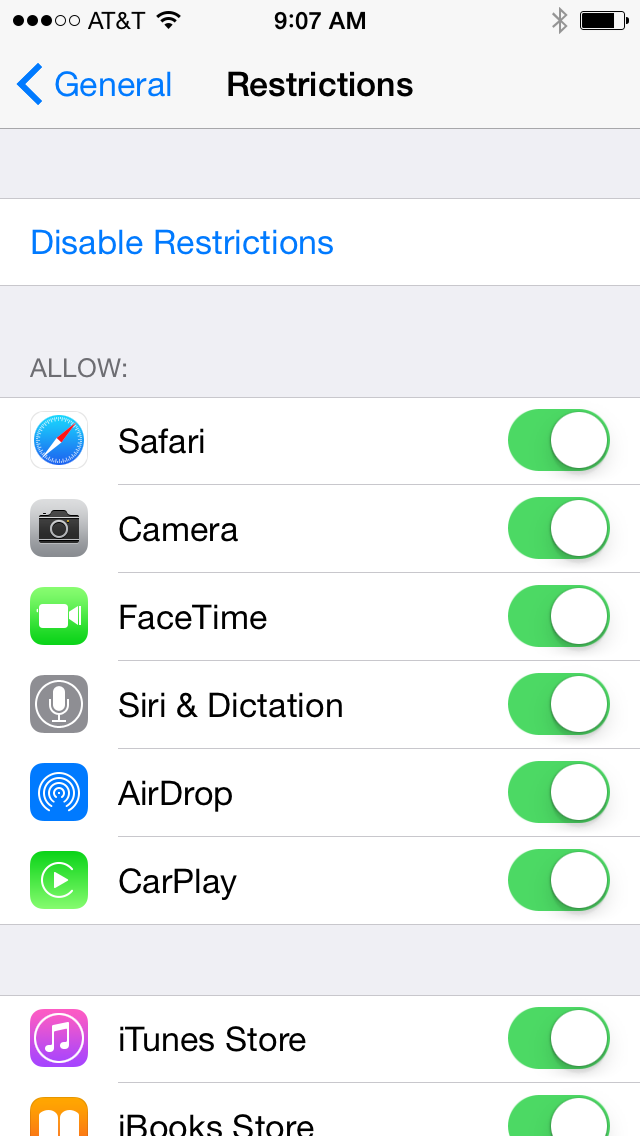
Our second discovery was Restrictions on Apple devices.  If you go to “settings,” “general,” “restrictions” you are able to set up a 4 digit passcode (on EACH separate device) and then set the age appropriate levels for many different aspects: music, apps, websites, games, etc.  It is the simplest, most effective way to limit what content they are consuming.  I wish I’d known about it from the beginning! One friend told me that when she gave her 10-year-old an Apple device she simply took off the Safari (web-browsing) app.  There are plenty of other fun ways to use the device without surfing the internet.

Here is a screen shot of the Restrictions menu.  It’s very simple to turn off certain applications or set maturity levels for various media.

IMG_5180

Third, we realized we must create our own account for whatever social media our children are using, and follow them.  Many parents (including myself) don’t necessarily want accounts on the apps their children are using.  But to effectively monitor your child’s usage, you need to take the time to figure it out and check on his activity from time to time.  My husband used this analogy: would you allow your child to have a locked room in the house that you weren’t allowed to go in?  Of course not. You need to be aware of what your child is doing on these sites.  This not only allows you to monitor his electronic activity, but also helps you get to know him.  It’s a little window into his world: his interests, his friends, what he’s posting or liking

Here’s a summary of our other rules or methods of dealing with electronic usage.

  1. The wifi goes off at 10:30 pm. We literally unplug the router because I couldn’t find a system that would turn it off for certain devices at certain times.
  1. The iPhone can still be used through its data, so her data is turned off at 10:30. I set this up on AT&T’s website through our account.
  1. We created an Open DNS account. I set it up to restrict adult websites all the time, and restrict social media usage (what Open DNS calls “time wasters”) after 10:30, just in case we forgot to unplug the wifi.
  1. We don’t allow use of electronics while making or eating food.
  1. Likewise, they are not allowed to use them during family dinner or family meetings.
  1. There is a time limit for Netflix watching.

We wanted to make a rule that they have to hand over the devices when we ask for them, because really they are ours. Even if they bought the device themselves, we pay for the phone service and the wifi.  We got a surprising amount of resistance on this, partially because we didn’t set this up as an expectation from the beginning.  They really believe the devices belong to them and that we are invading their privacy by looking at them.  I can understand their position somewhat.  On the one hand, we as parents need to be monitoring not only the amount of time they use devices, but also what they are doing on them and with them.  However, it is also like reading their diaries in a sense, or listening in to both sides of their phone conversations.  It’s a tricky balance.

I decided to set one hour a week when they give their devices to us.  We chose Sundays from 6:00-7:00.  The regularity helps solve a few of the problems.  First, it gets the girls in the habit of handing over their devices.  It is a weekly reminder that the devices do not belong solely to them.  Second, it gives us a weekly reminder to check on what they are doing.  Without a system or routine, we tend to forget to do this regularly.   We look over their usage and do a quick check (or a lengthy one, if warranted) of their texts, emails and posts.  This is not a complete solution.  They still can and might delete their web page history or texts.  We just have to trust that we have a good enough relationship with them and have taught them correct principles well enough that they will make good decisions.

We do allow exceptions to these rules, especially when the children calmly explain what they want.  As I explained in the post Use Your Words, I want my children to learn that the more words you use the more likely you are to get what you want.  For example, if friends are over, the internet can stay on beyond the usual time. Or, over Christmas break if they want to watch an extra show on Netflix, that’s okay.

Here is a link to a blog with more tips on parental restrictions.  There’s a menu at the top with options for various devices and apps.  It can be complicated and time consuming, but that’s what parenting entails in the 21st century!

Once you’ve decided the rules for your family, give yourself permission to change them as needed.  If you try the rules out for a few weeks or months, you may find they don’t work for various reasons.  It’s okay to say to your kids, “We’ve realized this isn’t working, we’ve reassessed and these are the new rules.” The rules are necessarily going to change through the years as your kids get older and the devices change.


Now we come to Step Two: Calmly enforce the rules.  The rules you decide on are somewhat arbitrary and may change, but once you have chosen your regulations, you can be certain you are doing the best thing for your family at this time.  If you are unsure, children can sense that and will test you more.  Also, being unsure makes you more frustrated and more likely to lash out at them (when it’s your uncertainty that is really causing the stress).  Be secure in your rules and present them in a confident, sure manner.  Also, present them in a positive manner, explaining that it’s your responsibility to keep your children safe and help them develop good habits around device usage, and that you want to encourage real things with real people as much as possible.

As you explain and implement the new rules, your children may (probably will) complain and balk at first, and you may be worried that it’s going to be terrible.  But, BELIEVE ME, I’ve done this many times and always found that they get used to the rules. As long as the rules are enforced in a calm, kind way, there will be no long term negative detriments to their health or well being, or your relationship with them!  At first it seems dreadful, but after a while everyone gets used to it, and things go smoothly.

For the first while we took away their devices for various lengths of time as the consequence of not following the rules.  But this started to feel like we were trying to “catch” them breaking the rules, and I felt it wasn’t conducive to a respectful and trusting relationship.  It finally dawned on me that I was not being true to the principles in this blog!  I was focusing on consequences (which were really just punishments) because doing so was easier and more straight forward.  We decided to change our ways and do away with any consequences, except in extreme cases.  Now we use the methods outlined in this blog.  In Stop and Redirect I explain how most misbehavior can be addressed with a simple reprimand and instruction.  In this case I would say, “Remember not to use your phone in your room.  You’re only supposed to use it on the main level.”  The next important step in managing children’s behavior is Positive Reinforcement.  We notice the times when they are using them on the main level and say, “Thank you for obeying the rule of being on the main level.  I appreciate that!”  We also make sure we Stay Close to Our Children in other ways, to maintain a positive relationship and to know what is going on in their lives.

We set up and modify the rules by having discussions with our daughters, listening to their points, and responding respectfully.  Through this process, they became invested in the rules and verbally agreed to follow them.  After that we give them the benefit of the doubt that they want to follow the rules, they just forget sometimes.  If they are repeatedly disobeying or forgetting the rules we would take the device away for a time (corresponding with the misbehavior) but that is not our first line of defense to encourage obedience.  When it was our first line of defense (when we were looking for disobedience and readily handing out punishment) it set up an adversarial relationship – one based on the premise that they will misbehave and we must “catch” them at it.  It just didn’t feel right to us.

So, in summary, to regulate electronics you apply all the parenting principles in this blog just as you would with any parenting dilemma. You explain expectations; you phrase it in positive ways; you reinforce the good behavior; you prevent your own irritation.  You address your own issues, and you practice patience.  Deciding the particular rules can be difficult, but after that you just stay calm and be kind!

There is another post about electronics here.  Some of the content is overlapping, but it is all important!

Resistance to Change

When you try any new “system” with your family or your children, they are likely to resist.  It is in children’s nature to fight the change, keep the old ways – especially if the new way means any kind of extra work.  I’m bringing this up because many times when parents come up against this resistance, they think they are doing the wrong thing, and they give up too soon.  As with so many areas of parenting, I want to normalize the crazy! We all go through this.  Knowing this resistance is normal and being prepared for it will help you push through with your new way of doing things until the family gets used to it.

For example, at some point your children will be old enough to start helping with chores.  Hopefully they’ve done little, age appropriate chores when they were young (making their bed, unloading the dishes), but then comes a time when you’re ready to give them real chores: daily dish or pet duty or Saturday jobs cleaning the house.  When you first introduce this your children will balk; they will complain.  They will perform the chores badly such that you feel it would be easier to do it yourself.  But don’t!  Be kind and calm as you continue to insist they do their chores day after day, week after week, and after a while, it will get better.  They will get used to this system as the new normal, and you will have extra help around the house!  It takes persistence and dedication from parents to get kids in these habits, but it will pay off in the long run.  Your children will be better trained to do chores obediently, and the younger children will follow the older ones’ examples (so it will be easier to train them to do their chores).

Another example is family scriptures.  Many families want to hold a daily devotional with their children: reading scriptures, having family prayer, and maybe singing a hymn.  If your family is not in the habit of doing this, and you want to start it, be prepared for rough waters!  In the beginning there will be a lot of resistance (the older the children are, the more verbal the resistance will be).  Younger children will misbehave, older children will roll their eyes and beg to be done.  But, stay the course!  Be kind and calm as you continue to insist that they stay in the room and participate (or just stay in the room and be quiet), explaining at times why this is important to your family.  I promise, over time they will start to behave and even enjoy this family together time.

Whether it’s a new chore chart, a new weekly or daily family meeting, or new rules regarding electronics, your children will put up a fight and try to wear you down until you’re tempted to give up.  This resistance is completely normal.  Don’t give it weight or too much thought or attention. You have to persevere for a few weeks before you can decide if the new system is a success or not.  Making these modifications will help your children get better at adapting to new situations, which is an important developmental skill.  Expecting resistance can keep you calm (and kind!) and give you the foresight to keep trying.

Improving Parent’s Behavior

Parenting advice is usually focused on what parents can do to improve or moderate their children’s behavior.  But sometimes it is the parent who needs to change.  You might need to learn how to stay calm in difficult situations, or create better habits about spending quality time with your child.  This can be a painful process, to evaluate your parenting and realize there are some places you are lacking.  It takes insight to see the areas for improvement, and humility to admit that you need to work on something.  But once you are able to focus on these areas and make changes, you will be happier as a parent and a person.  If anger is controlling your responses to your children, you can find more peace when you learn to control that anger.  If you’re being reactive as a parent and blowing things out of proportion, you probably regret it later and resolve to do better.

If you have seen a need for change and are ready to work on some aspect of your parenting, I want to applaud your efforts.  It takes maturity and strength to improve yourself.

Parenting is overwhelming – for everyone! So if you’re ready to make some changes, start small.  Realize that changing thoughts, feelings and responses takes time.  Go easy on yourself as you make progress.  Here is my formula for how to change.   It sounds easy and straight-forward as I type it, but we all know it is not.  You will have to repeat this process over and over to see progress.

First, assess what needs to be changed.  Just like when you are writing those New Year’s resolutions, try to be specific and reasonable. There may be many areas you want to work on, but just start with one.  Even a goal such as “I’ve got to be more patient” is too broad and overwhelming.  Focus in on one time frame, for example, “I want to be more patient at bedtime.”

Next, figure out the better way.  What will the new and improved behavior look like and sound like?  Make a list of specific ways you are going to respond or specific things you are going to do to improve.  Write notes to yourself and place them in the bathroom, kitchen, anywhere you will see them often.  Continuing with the ‘patient at bedtime’ example, try to identify what moments or interactions cause your frustration and what your usual response is.  If you know those moments are coming, you can make a plan for how to respond more positively.

Finally, implement the better way.  Each time that situation comes up, try to remember what you practiced and planned.  Over time these purposeful, proactive responses will become your normal, replacing the negative automatic reactions that come so quickly in the heat of the moment.

Sometimes the change you need to make has to do with your own issues.  Here are a few emotional issues that get in the way of effective parenting.

Your parents. Most people respond to their children in the same way their parents did. You may have never thought about it before, but it’s a good idea to reflect on this.  Ask yourself if you’re doing the same things your parents did, and if that is how you want to parent or not.  This is part of intentional parenting, instead of doing whatever comes naturally.  Your answer may be that yes, you want to be like your parents and follow their example.  On the other hand, you may realize there are some things they did that you want to do differently.

The first step is to identify exactly what habits and family patterns work for you and your family and those that don’t.  It can be hard to do something different from your parents because they might be hurt that you chose a different path, or be disapproving of your choices.  It’s also hard to do something different because your automatic habits will be to follow their example.  Sometimes these reactions are so ingrained we don’t realize what we’re doing or it seems impossible to change.  But following the formula above is a good place to start.

You must also be aware of the risk of overreacting.  If you didn’t like something your parents did, like forbidding sleep overs, you might do the extreme opposite without really thinking it through.  You might be very lax in your rules about sleep overs and not realize the possible detriments to your children.  Allowing sleep overs or not is not the point, of course.  The point is you should make purposeful decisions based on you and your spouse’s examination of your feelings and the information about the situation. If parenting differently than your parents did is one of your emotional “issues,” than work through that and be aware of its effect on you.

Your pride.  I wrote about this in the Parenting without Irritation post. In a situation where you feel watched, where people might be observing (and maybe even judging) how your children look and act, you can’t help but feel a little more anxious, a little more easily annoyed.  And this feeling affects your parenting – you are short with your children, less patient and more on edge.  The “observers” might be your parents or in-laws, co-workers or friends.  Special occasions or places with certain expectations of behavior can be potential traps for pride flare-ups.  This is a natural reaction.  If you realize it and even anticipate it, you can modulate your own feelings and be ready for the situation.

You might do a little self talk, like this, “I know you want the kids to look and act their best today, and you will feel like people are watching what they do, but they are just kids and won’t be perfect.  I can talk to them beforehand and explain my expectations of them, but if and when they misbehave I can still be patient and calm, and speak kindly to them as I try to get them to obey.  Most people there have kids and know what they are like, and most people won’t be paying as much attention as I imagine that they are. My overreaction is worse/more embarrassing than their misbehavior.”

If you find that your pride is creeping up regularly, take a look at it and see what you can do to keep it in check.

Your marriage. I think we are all aware that the quality of your marriage can greatly affect your children. The most obvious way this affects your parenting is if you and your spouse are not on the same page regarding parenting principles. When spouses have differing parenting styles it can be confusing for children, and they sometimes play off of each parent to get what they want.   You might have to put extra effort into communicating about how to raise your children and find a way to compromise and work together.  There are many arbitrary decisions and rules in parenting, and therefore many areas of compromise that won’t have lasting effects on the children.  There are some important basic principles, though, that you will hopefully agree on.

Even if you and your spouse agree on parenting principles, if there are other trouble spots in the marriage it can affect your children.  It takes emotional energy to deal with marital difficulties, and that takes away from the emotional energy you have available for your children.  If this is a problem for you, do whatever you can to address those issues and strengthen your marriage.  Talk to your spouse, read a marriage-improvement book, or get counseling together.  Any effort you put into your marriage will directly benefit your children and make you a better parent.

Your self-image. In your child’s world, the boundary between self and parent is very blurred, maybe even nonexistent. Children see themselves as one with you.  Separating from you is part of the growing up process.  Therefore everything you say about yourself, you might as well be saying about them.  Hopefully you already have a positive self-image, but if not you should try to find out why and work on it.  Even if you don’t say negative comments out loud, your child can pick up on subtle cues exposing your dislike of yourself (and he internalizes them to dislike of himself).

But one thing you can absolutely control (though it may be difficult) is those comments – what you say out loud about yourself.  You should never put yourself down in front of your children.  In fact, do the opposite.  Make a point of saying comments like, “I’m having a good hair day today!”  or “Wow!  I made a really good dinner tonight.”  It feels silly at first, but you’ll get used to it.  And it is as beneficial to your child as giving him or her a compliment.  Don’t you want your child to feel and say those same things about herself?  Then you must model it.

When you get home from work say, “I really helped someone at work today; let me tell you about it . . .” Another example: “I’ve always thought I have a really nice smile.”  It sounds crazy because who would really say that out loud?  But again, it’s powerful modeling.  Keep these comments coming, both about superficial things (looks, hair, clothes) and deeper things like solving difficult problems or working on relationships.  Give your children an insight into your (positive) world.

This goes for eating issues, also.  Daughters especially pick up on their mother’s eating habits and body issues.  I try not to ever mention I’m on a diet or talk in depth about the calories or fat grams of any food. Don’t demonize food or fat; just have a neutral attitude toward all food.   I try to have the attitude of ‘I eat in moderation and I enjoy whatever food I’m eating.’  This may not be what is really going on inside, but having this attitude for your children’s sake can change your internal dialogue permanently and give you healthier self-talk.  It will be better for your own health and self-image to speak positively about your body and not negatively.  Making a point to say positive things in front of your children will force you to focus on the positive!

All these difficulties and issues are a part of everyone’s life; no one is immune.  But we need to be aware of how they are affecting our parenting.  Once the effects are identified we can be proactive, making choices that are purposeful and best for our families.

Improving Children’s Behavior

When you hear parenting advice that says, “When a child has such-and-such problem, here’s what you should do”, it implies that the problem will go away.  It sounds as if now you have the answer; all you have to do it follow that advice, and your problems will be solved.  Most parenting books or blogs don’t emphasize the slow nature of changing behavior.  It takes a long time to change!  When is the last time you accomplished your New Year’s resolutions in the first month?  More likely you are working on the same resolutions year after year!  When you try to do the right things as a parent and don’t see rapid improvement, don’t lose heart.  Have confidence in what you are doing and remember, it takes time for children to change and improve their behavior.

Think of your efforts as an investment in good behavior in the future.   And remember that as the child gets older, his behavior will naturally improve.  While you are waiting for that time, be kind; be patient with him.  Look at behavior in large, overall sweeps; don’t inspect each behavior or each day with a microscope.  Don’t get too bent out of shape about infrequent misbehaviors, or too worried about how to handle or fix one specific situation.  You won’t know exactly what to do in every situation, and that’s ok.

Raising children is like painting a landscape of a wheat field.  The individually painted stalks of wheat can be compared to interactions with a child or days spent parenting.  They don’t look like much on their own.  Even a few of them together look scraggly and small.  It takes many, many stalks of wheat to make a beautiful painting.  If a few of the stalks don’t turn out great, that’s all right.  The overall look of the painting is what matters.  It can take a long time to feel like your child’s behavior is improving, to see that big picture, but all your efforts count and help in the overall product.

Remember that a child’s behavior is molded more by positive reinforcement (noticing the good) than by negative reinforcement (reprimanding, punishments).  If there is a specific behavior you want to change in your child, sit down and write out the problem behavior and its opposite.  Then focus on complimenting the opposite! Reinforce the behavior you want.  Another strategy is to make a list of anticipated problems (things you know go wrong daily or often) and write your proactive responses to them.  Then practice them! These and other principles outlined in this blog will help guide you in your parenting.  Your child’s behavior will eventually improve, and you will have a positive relationship with him all along the way.

Parenting without Irritation

The more I learn about effective parenting (from observation and from study), the more I realize parenting without irritation is a key principle.  I used to joke with my husband that this would be the title of my parenting book, were I to write one.  As I have watched other moms that I admire, and as I’ve “experimented” with my own children, I’ve found that the most successful parents are the ones who enforce the rules, but don’t get irritated by the misbehavior. Let’s be honest, a lot of children’s behavior IS irritating.  They whine and cry and say the same things over and over and want to do things on their own and tell you that other kids have it better.  The list is endless!  But you’re not going to be an effective parent if you are consistently irritated.  So, take a deep breath and pretend you aren’t irritated.  Learn to tune out the annoying stuff and focus on the cute and good stuff. It’s really a tricky thing, though because you can disengage and not care what they are doing and not “toe the line” or enforce your rules – then you are not irritated, but you’re also not parenting effectively.  So the trick is to monitor and correct their behavior WITHOUT becoming irritated!  You say what needs to be said, “You may not drink fruit punch over the carpet,” “You need to finish your chores before playing with friends,” etc., without going on and on. Here are some tips for staying patient and not getting irritated.  See also Practice Patience.

How to Avoid Becoming Irritated

1. Ignore inconsequential behavior. The majority of annoying behavior is not really “misbehavior”.  It may not be your favorite behavior, but it’s not worth it to draw attention to it (and possibly reinforce it in the process).  Let these behaviors serve as a reminder to give Positive Reinforcement.  A classic example is nose picking.  No parent wants to view this, but many have found that asking them to stop doesn’t work, or sometimes makes it worse.  The best thing to do is say nothing when he is doing it; then find a time when he is not doing it and say, “Thanks for not picking your nose while we talked!  Mommy likes that.”  This may sound a little ridiculous, but do this a few times, without sarcasm and without making a big deal of it, and you will see the behavior change. On the other hand, if you’re asking him to stop all the time you’re not only drawing his attention to it, but yours, and then you feel irritated because “he picks his nose all day long!”  Tune out the unimportant but annoying behaviors and choose to focus instead on the things the child does right.

2.Understand the child’s developmental level and have appropriate expectations. This is one of many places where my favorite phrase needs to be repeated over and over, “That’s just how kids are.”  Kids take a long time to get ready for bed; they have to try to do things themselves; they have to see things or know the answer; they aren’t very patient; they hit others easily and often; they can’t stop talking.  These are normal behaviors for kids, but yes, they can be irritating.  But knowing that these behaviors are part of their developmental process can help.  You have to take the bad with the good, and just get over it.  Certain things are too much to ask of children.  Be familiar with what to expect at each age and what they are capable of. If you’re feeling frustrated repeatedly with a child over a task such as not cleaning up or not eating by himself or not dressing herself, you are probably expecting too much! She may not be ready for that task, and you have to take your expectations down a notch, which can be frustrating, I know.  You really think the child should be able to do this task, and you want to hold on to that and make her do it, but the end result is you’re getting frustrated over and over.  So it’s better to tell yourself, “That’s just how kids are,” “It’s too much to expect.”  And let it go. Sometimes the child will have performed that task last week, but that still doesn’t mean that he can necessarily do it this week.  Children’s progression is not linear; it’s not a straight line up the graph, getting better and better each day at responsibilities.  It’s an up and down line, which is so maddening to adults!  They will be doing something for a while (making their bed, playing on their own, sharing their toys, etc.) and a few weeks or months later they’ve gone back to the old, less desirable behavior.    You always have to remember that what a child can do one day or month he can’t necessarily do the next, and don’t be irritated by this fact!  If he is progressing or focusing more on large motor skills (climbing, riding a bike) then his attention skills may suffer during that time, or vice versa.  This is not a conscious choice for the child, it just happens.  Lots of progress in speech can accompany a slide in a child’s ability to unload the dishwasher without a fuss.

3. Set up the environment for success. This has a lot to do with having appropriate expectations of your child, but takes it one step further  – reminding you to arrange your home and your day so he can be successful.  Look at the situation you are repeatedly angry about and see what you can do to fix it.  Maybe you are not allowing enough time for the child to get ready for bed or ready to leave the house.  Maybe you need to spend more time and attention with him to help him through that process.  Maybe you’re expecting him to not get into things that are at his level, your make-up or cereal boxes, for instance.  You might need to rearrange the environment so he can make good choices.  Maybe you’re expecting him to get along with his brother for long stretches of time.  You have to remember there’s only so long that will last. Be proactive – not reactive! Think about situations ahead of time and how you are going to handle them.  If you’re going on a long car ride or an extra long church meeting, think through what you can do or bring to help the child get through it with good behavior.  What often happens is the parent hasn’t thought through the situation, and the child starts to misbehave, and then gets in trouble or frustrates the parent.  It’s on us as parents to be prepared for what the situation will entail. A quote from The Power of Positive Parenting:

When we see frequent inappropriate behavior, we should ask, “What are the consequences that are shaping and maintaining that behavior? What must we do to arrange the environment so that the behaviors that are in the children’s best interest are properly taught and reinforced?”

4, Reframe the behavior. If you try to understand the motivation behind an annoying behavior it can become easier to take.  A child who swears is trying out those words to see how it feels to say them (not that this behavior should be ignored, just dealt with in a teaching manner rather than a punishing manner).  The child who insists on putting on his own shoes is trying to be independent (and we all want independent children eventually!).  You can also reframe to “Looks like I haven’t taught him the correct behavior yet.”  Then you’re not annoyed by the misbehavior but reminded to teach him the right way to act.  A stubborn child who must get her own way is going to be a very successful adult (studies have shown!).   Looking at the situation in a different, more positive light can help reduce the irritation.

In between writing and publishing this post I was able to apply this principle.  I’d purchased an online winter driver course for my almost-16-year-old daughter and wanted her to watch it.  She had expressed interest in it before I bought it, and it would expire in two weeks, but now she was being negative about it and putting it off.  I was getting irritated and starting to nag, when I realized that she’s nervous about driving in the winter, and that anxiety was behind the dawdling behavior.  Realizing this didn’t change the fact that she needed to watch it, but it greatly reduced my irritation and helped me empathize with her and help motivate her in a loving way.

5. Don’t give unrealistic consequences. If you give excessively long or unrelated consequences the child is not going to learn from them and chances are you will not follow through.  Then you become irritated because she doesn’t listen to you, she doesn’t obey what you say, she’s not made to obey by the threat of consequences.  You feel ineffective and like you have no tools to draw on.  All that can make you very irritated!  You have to remember to say few words, focus on the good, give consequences sparingly and that are close in time and related to the misbehavior and follow through on them.  See Stop and Redirect.

6. Create positive interactions with your child. When your child is having a particularly hard time obeying (a phase over a few days or weeks) this is the time to spend a little extra time with him.  Give him your love and attention and he will feel comforted, but you will feel more positive about him also!  Many days all we do is critique – point out the negative behaviors.  That does not build positive relationships.  That can become a relationship that the child wants to get away from when he can (in adolescence).  You have to point out the good and take extra time to create positive interactions.  Do something that both of you enjoy.  Then you will see and feel the good in your child and not be as annoyed in the hard times.  See Stay Close to Your Child.

7. Identify what is behind or causing your irritation. Sometimes your own issues get in the way of enjoying your children and disciplining/teaching them appropriately.  It takes some insight to realize this, but when I examined my feelings I often found the following factors were at the heart of my irritation.

  • My pride. I am extra irritated when my pride is on the line. If we are at a public event where specific behaviors are expected, I am extra irritated with misbehavior.  When my parents are around and “observing” my parenting, I am extra irritable.  These are different moments for each individual person, depending on what matters to you.  But when your pride is on the line you have to stop and realize that.  Have some insight into the fact that this is YOUR issue, not the kids’.  The kids are being the same as they always are!  They’re just kids, sometimes behaving, sometimes not.  But if I have extra hyped up expectations of them, I’m likely to be extra irritated.
  • My indecision. There are many times when I’m not sure what the right answer is. Should I let her quit piano?  Should I make her sit right by me at the function or let her run around? Should I let her spend all her allowance on silly trinkets?  These are tough parenting decisions, and I feel like I get more irritated with my children when I don’t know what my right answer is.  They keep asking and I can’t decide, or I decide one thing and then question it.  Again, it’s okay to struggle through these times, but I just have to remember the reason my irritation is heightened.  The child’s behavior hasn’t changed.  They are always going to beg for what they want and ask for things that probably are not in their best interest.  I’ve found that I’m less irritated if I just make a decision and stick with it.  Many of these decisions are arbitrary anyway!  Just decide and follow through, and that reduces irritation.
  • My lack of follow through. When I say, “It’s time to go,” and then talk and talk, I can not be irritated that they are not waiting at my heels, coats and shoes on. Of course they are off playing!  They know that “It’s time to go” means “You can play for 5-10 minutes while I talk”!  The more I say things I don’t really mean (I’m going to take that away, it’s time for bed, etc.) the less the children will behave.  And that causes me to be irritated: “Why don’t they listen to me?!” I must remember to only say what I mean and follow through with what I say.
  • Parenting books. Parenting books cause me frustration. They say, “If child is doing X, you should do Y,” and infer that doing Y will make the behavior will go away. They set you up for disappointment!  I’m not saying don’t read them (I am addicted to reading them!) but I just have to keep in mind that any change takes time.  There is no magic cure. And kids are going to be irritating and misbehave no matter what you do.

I want to reiterate that the best thing I did as a parent was identify an overall philosophy (which is what this blog is trying to give you) and not get caught up in the small, frustrating interactions.  When I had a clear vision of parenting principles and things I was trying to accomplish (stay close to your child, have positive interactions, stay calm, etc.) then I could get through the tough times without overanalyzing or getting caught up in the emotions.  Before I had my core parenting principles I felt like each day I was judging myself and my child based on current, minute-to-minute actions.  It was maddening to have to worry so much about what the right choice was.  Once I developed my core principles I could relax a little and avoid getting overly irritated.

Practice Patience

Patience is a commonly sought-after virtue among parents.  Children are exasperating and can quickly extinguish any intentions you had of being patient that day.  Some people may think patience is not part of their personality, but it is in fact a skill, something that can be practiced and improved.  It takes a long time, and the progress is slow and steady, but don’t give up on yourself or get discouraged.  Just know that the more you work at it the easier it will get.  Do the hard work in the beginning, and it will pay off in the long run. If you’re having a rough day just think you’re laying the ground work for a better future.  Here are some ideas and suggestions to help you keep your cool.

*Count how long it takes.  This is a technique I developed around the time my toddler wanted to put on her own shoes (“I do it myself!”).  It seemed to take forever, and it’s SO boring just standing there waiting for them to do something that I could do in a jiffy.  And actually it’s the standing there part that takes the most patience. Even if I completed the task in the same amount of time, it would feel better because at least I was doing something.  So, I decided to start counting to see how long it actually takes her to put on her shoes, or complete whatever task she insisted on doing herself.  If nothing else, it gives you something to do while you stand there waiting!  Guess how long . . . about 30 seconds!  I rarely got to 30 before she was done.  I decided I can wait 30 seconds for her to have her way, learn independence, and have my approval for a task completed.  It’s important for children to do things on their own, of course, and this technique helped me get through those tiresome moments.

*Take it down a notch.  When I was in training as a social worker I learned about de-escalating tense situations.  When people are angry or in an argument tensions can get high, and if one person starts yelling or getting physical, the others will follow or even go one step more.  One of the techniques to de-escalation is speaking calmly and slowly.  Others will be influenced by your speech volume and pattern, and everything will start to calm down.  This is an excellent way to stay patient with frustrating children.

When you feel yourself getting worked up, think “take it down a notch.”  Visualize a peg being taken out of a high hole and moved down to a lower one.  Slow down your actions, lower your voice.  Pretend you’ve been given a sedative, and everything is slowing down.  This gives you time to think before you speak and will help you avoid doing anything you will regret. Sometimes you have to “act” like you don’t care as much as you do (about the dirt tracked on the carpet, or the hit to the sister, or the tantrum occurring before you) because caring will just make you mad, and there’s no benefit to that.  What would someone who didn’t care look like and act like?  Think about that and be like that, just for the time being. You can decide how you’re going to deal with the problem behavior later, when you are calmer.  When you’re getting angry and upset all your blood rushes to your heart and limbs (fight or flight mode) so it’s not the time to problem solve or react with a punishment.  Just take it down a notch.

*Visualize your body melting.  This is related to the above technique, but a different visualization.  For a few seconds try to relax your muscles – starting with your head and face, down through your shoulders and arms, down your legs, finally to your feet. Feel yourself getting calmer.  Try to let go of the anxiety that is building in your core.  It’s not helping anything!  It’s not productive.  Take a deep breath, maybe close your eyes if that helps, and picture your body melting.  Again, realize that you’ve just got to get through this situation without doing or saying anything you regret, and then you can deal with the problem behavior when you are calmer.  You will deal with the behavior by reviewing the other principles in this blog: assess the situation to see if you are expecting too much, if the environment is setting him up for success, if you are complimenting the desired behavior, if you’re spending enough quality time with him, and make a plan for what behavior is expected and what you’re going to do if that doesn’t happen.  When you have a plan in place (and a general parenting philosophy) there is less reason to get upset.  Yes, it’s frustrating that he is misbehaving (AGAIN!) but you know what to do about it.

*It’s better to forget and smile than remember and hurt.  I kind of hate this saying, because it’s so true.  I want to remember; I want to tell everyone how bad my child is and how she makes me suffer!  I want my husband to know how hard staying home is, so I’m going to hold on to the anger and the hurt until he gets home!  But who is that helping?  No one.  It’s only hurting myself.  I’m the one who carries around that dark baggage all day (or week or year!).  For the little things, it’s better to get over them quickly.  I had this saying taped up on my wall for over a year.  It’s a hard habit to break, but just let the happiness in!  Move on!  Now we’re in the next moment, and there’s a chance the child will behave, and you’ll have a great interaction.  Forgive her and smile!

*“That’s just how kids are.”  Another phrase to repeat or hang on your wall!  I have to tell myself this one all the time.  Sometimes children are SO exasperating, SO frustrating that you are sure this can’t be normal!  I used to always think to myself, “Either there is something wrong with her or there is something wrong with me!”   I actually made an appointment with the pediatrician when my oldest was about 6.  I had had it.  I just felt like nothing I was doing was working, and I was getting so angry and frustrated.  I started to wonder if there was in fact something wrong.  He was so kind and patient with me.  He started out by going through a long checklist of behavior problems, and to almost all of them I said no, she doesn’t have or do that.  It was a real eye-opener to me.  There are a lot worse problems out there than what I was dealing with!  In the end, he said, “I feel like I could be talking to my wife – she has the same worries and concerns – but your child is absolutely normal.”  As you can imagine, I was about in tears!  It was so relieving, but also a little scary.  You mean, that’s just how kids are?!  Who came up with this idea?!  Who ever thought that we, weak, flawed parents could deal with this?! Sometimes I turn comedian and say to myself, “Have you heard what they say about parenting? It’s hard – yeah, that’s what people say, so I guess I must be parenting!”  Everyone knows parenting is hard, but it’s so very, very hard when you are the one doing it!  But you can take comfort in the fact that everyone is in the same boat.  That’s just how kids are – pestering, inquisitive, non-stop talkative, stubborn, resistant to sleep, picky eaters, bad friends, at times violent, impatient, and without manners!  But, knowing this truth can help us be more patient.  Understanding what is reasonable to expect and what isn’t can help us set up the situation for success – for both us and our children!

*Now is not forever. This follows nicely after “that’s just how kids are” because here’s another truth about children: They will change!  They will grow!  They will learn (eventually)! The saying ‘now is not forever’ is true in many parts of our lives; our problems, feelings, relationships, even health issues ebb and flow.  But it’s especially true with parenting because our children are getting older every day.  They are maturing and developing greater capacities to modulate their emotions and use their words.  They are becoming more independent and reliable (don’t expect too much too fast though!).  Just repeat this mantra over and over, and imagine the day when you will miss the messes and the noise.

*Don’t lose your cool.  I know this is obvious, and you are thinking – if I could do this I would be a patient person!  But I want to say this to remind you that it’s not worth it.  It feels  good for a moment to yell and get really angry and maybe even spank, but it does not have any positive benefits.  It’s easy to give in to speaking harshly and to negativity.  I’m sure you’re like me and have thought of saying some terrible things (and some hilarious, sarcastic remarks, too!) but you must control your words and not speak them.  To say mean and harsh things to children is to show that you have as little control over your actions as they do.  It does not show the example you want to be of controlling words and actions, even in times of strong emotion.  Isn’t that what we ask of them all the time?!  When you lose it with a child, her behavior will worsen, not improve.  She will use those same words and tones with her siblings.  It’s just a negative cycle.  It is so, so, so hard to control your tongue in these super angry situations, but you must keep trying.

If you fail, forgive yourself quickly and move on!  You can apologize to your child, if appropriate.  You could say, “Mommy felt very angry and said some unkind things.  We are supposed to use our calm words, even when we’re angry, and mommy is going to try to do better in the future.”  It’s not going to be the end of the world, just review the principles in this post and start again tomorrow!

Use Your Words

You’ve all heard this phrase, “Use your words,” and most likely you’ve said it to your children.  But I’m going to show you a specific technique that really teaches children what words to use and how.  The goal is to teach them to problem solve on their own and help them express their feelings.  As I’ve said before, words are very powerful and this simple tool can help diffuse many emotional situations and solve problems so easily – you’ll be amazed!  The foundation for the technique is that people, including children, want to be listened to and validated, more than they want the thing they are fighting for.

So, it works like this.  Say one child has a toy truck and another comes over and tries to take it.  The first child cries or fusses and the second does also.  I walk over and say, “Use your words.” Now if that’s all I say, the child doesn’t know what words to use or how to navigate this situation.  They may learn over time or get a little better at it as they get older, but what I have found is so effective is to teach the child the exact words to use.  Like this:

“Use your words, Tommy.  Say, ‘Can I have that truck?’” Hopefully Tommy says this phrase.  If he refuses or is too young to really say it, then I turn to Sally and say, “Tommy says, can I have that truck?’”

I look at Sally for a response.  She might say, “Sure” and give it to Tommy.  Often this happens because, as I said, the words diffuse the emotions.  But just as often Sally looks upset, thinking you’re going to make her give the truck to Tommy and she doesn’t want to.  So I say to Sally, “You don’t have to say yes.  You could say, ‘I’ll give it to you in 5 minutes’ or ‘I’m playing with it now’.”  Sometimes I might ask her straight out, “Do you want to give the truck to Tommy?” and if she shakes her head no then I give her some suggestions of what to say.

Or Sally might flat out say ‘no’ and then I turn to Tommy and give him some suggested phrases.  “Tommy, you could say, ‘Can I have it in five minutes?’ or ‘How long do you want to play with it?’”

The “How long do you want to play with it” is a useful phrase because it gives the child a sense of power – she gets to choose.  Most often she will choose a reasonable amount of time (3 or 5 minutes).

If Sally is really not wanting to give up the toy, I would say to Sally, “Tell Tommy, ‘I just got this truck and want to play with it for a while.’”  You teach them to say whatever fits the circumstances.  Maybe, “I brought this toy from home because it is my favorite, and I want to play with it.”  Or “I want this spot on the couch because I like being next to mom.” Or “I don’t want you to borrow my clothes because sometimes you don’t return them.”  You have to teach them EXACTLY what to say to solve the problem.

The point is not to get them to share or be nice or do any specific behavior.  It’s mostly to use specific words to solve the problem.  The problem can be solved by keeping the toy!  Using words in this way helps everyone in the situation feel good about the solution, whatever it is.  As soon as a child is old enough to take away another child’s toy (or care if her toy is taken) this technique can work.  She may not be able to say it, but you can model it and she can start to understand the meaning.  You tell her what to say, and then say it for her, if needed.

When kids are older and get in more heated arguments we do the same thing but even more involved and more words.  First I ask each child to tell their side of the story, without being interrupted by the other child, and then I start to mediate.  I say, “Tell Shelly, say ‘I don’t want you to play with me and my friends because I just want some time with them to myself.’”  I make her repeat those words, even though I just said them standing right there.  If she doesn’t want to say it or feels silly, I remind her that she needs to practice these words so that she can do it on her own next time.  She says the sentence, and then I coach the sister on what to say in response.  After a while they know what to say or how to express themselves and don’t need as much coaching.

Sometimes they get sick of the whole process and don’t want to participate, so I remind them, “The more words you use the more likely you are to get what you want.”  I really believe this is a life-lesson truth.  Whatever situation you are in if you can ask for what you want, express yourself clearly, stay unemotional and use your words, you will get what you want.

I use this same technique when my kids are asking me for something.  The more words they use describing why they need it and what it’s for, the more likely I am to get it for them.  Sometimes they are too frustrated with me to go to the effort of explaining all that, and in that case, they don’t get the thing they want.  I don’t just say, “Use your words!” but I teach them just what to say.  For example, “If you wanted to stay longer you can ask me, you could say, ‘Mom, I’m having a lot of fun playing with my friend.  Is there any way I could stay a little longer?’”  You can have them repeat that back, if the moment is right, but even if they don’t they start to learn the words/phrases.  There are hundreds of different applications of this, and the more you take advantage of a problem situation and teach them the words – the exact words – in this way, the more words they will know to form their requests and solve their problems using words instead of whining/hitting/etc.

One of our family mottos is “ask for what you want.”  My kids know that means use your words, and use lots of them.  As you know, it’s more natural for children to say, “I need more milk” than to ask, “Can I have more milk?”.  Whenever this comes up I say, “That’s a statement.”  I explain (in a nice way) that they are stating what they need, not asking me to do something.  Again, I give them suggestions of words and phrases they can use. “If you would like more milk you could say, ‘Will you get me some milk?’ or ‘Can I have more milk?’ Adding a ‘please’ on there helps too!”

Mostly I wait to get them the thing until they have asked, but if the moment is tense and it will become a control battle, I won’t make them.  I do try giving them an option, “You can either say ‘please’ or ‘will you’.  You don’t have to say both.”  You probably know that kids like options, it gives them power, and it’s an effective tool for eliciting cooperation.  So, they have that option and usually they will comply with one or the other.

I’ve been through this scenario many times with my kids, as you can imagine, so by now I just need to say, “That’s a statement,” and they know to re-phrase!

This mediation and teaching process can take some time, but it’s worth the effort because it teaches your child how to express himself, helps him feel validated and listened to, and solves the problem peacefully rather than contentiously.  If you leave these arguments up to the children they will escalate and you will get mad and send them all away and no one will be happy.  Using this technique greatly reduces the contention in the home and the need for “discipline” or punishing.  It also teaches the children to ask for what they want in a calm and specific way, which will be a great asset to them in life.